CORE GOTECH TIP · FROM THIS LESSON
A plausible normal explanation is not proven operation.
The coil debrief leaves operating-circuit health as a separate question.
Expected voltage is not the same as proven operation →
GOTECH STUDY GUIDE · LESSON 03
Use circuit state and equipment differences to decide what a result supports, then compare competing explanations without jumping to a part.
CORE GOTECH TIP · FROM THIS LESSON
The coil debrief leaves operating-circuit health as a separate question.
Expected voltage is not the same as proven operation →GOTECH TIP · FROM THIS LESSON
The manual and automatic blower examples need different explanations.
A different control design needs a different explanation →A symptom, reading or visual clue is evidence—not automatically a diagnosis. Keep the observation, the possible explanations and the evidence needed to separate them in different notes.
WAY OF THINKING
What are we actually trying to establish?
What components, circuits, networks or relationships matter?
What did we actually observe, and what are we inferring?
What does this measurement, source or test establish, and what remains unknown?
What additional evidence would reduce uncertainty the most? Choose a check that helps distinguish the remaining explanations.
Do not turn a plausible explanation into a confirmed fact.
Before you start Study Lesson 2's closing quiz first. Know the difference between a supplied observation and the explanation you attach to it. Foundations ↗
01 · MAKE A PREDICTION
A circuit shows the voltage you expected. Does that finish the diagnosis? The quiz debrief starts here, then the blower examples show how the same symptom can lead to different questions.
Try the reasoning checks →FROM THE ORIGINAL LESSON
The original lesson debriefs the coil quiz, then compares manual and automatic blower-control diagrams. The examples explain reasoning; proposed checks are not reported test results.
Video loads only when you choose to play.
YouTube connects only when you choose to play.
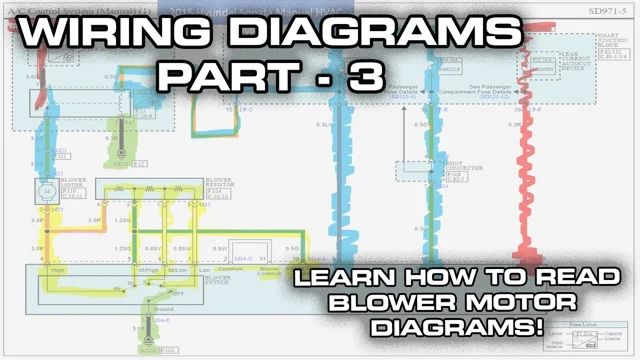
Watch on YouTube ↗ · Wiring Diagrams Part 3 - How To Read Automotive HVAC / Blower Motor Control Wiring Diagrams
Watch straight through, or use the source moments below to revisit a specific explanation.
FROM THE ORIGINAL LESSON
The instructor explains how the quiz's reading can be expected in its stated open-switch condition. He also rejects the conclusion that this proves the primary circuit healthy. The supplied reading does not establish acceptable resistance and current behavior during operation.
Complete both sentences: this reading can be explained by…; this reading does not yet prove…
In the cited Sonata manual-HVAC diagram, the presenter locates the blower, relay, resistor and control components. He distinguishes ignition-feed states, then contrasts lower-speed resistor paths with a high-speed path that bypasses the resistor.
Why it matters The comparison gives the symptom meaning. A difference between operating paths is more informative than simply noticing that a resistor is present.
Compare the high-speed and lower-speed paths in the source drawing. Which part of the explanation is different?
For this illustrated manual design, high-only operation directs the instructor's attention toward the resistor path. Losing every speed changes his first area of investigation. Neither statement is a demonstration of a failed part or a completed repair.
Why it matters You can use evidence to narrow a question without pretending it has already answered the question.
Explain why high-only and no-speed symptoms do not begin with exactly the same reasoning in this example.
The automatic-HVAC example uses a FET-controlled path rather than the same discrete resistor-speed selection. The instructor discusses comparing command, measured response and application-specific service information. He does not provide a complete command-to-voltage table or show that comparison as a live test.
What would you need to know before deciding whether a response matches a commanded blower setting?
Keep this example in scope This companion does not turn the source's proposed jumper tests into live instructions or fill in unexplained internal signals, exact gate values or inconsistent intermediate-speed labels.
GO DEEPER
These reviewed explanations draw on their own source examples. Keep each explanation within its stated scope.
Use three labels in your notes: given in the source, inferred by the presenter, and still unknown. Leave missing details open.
Review the foundations →Educational reading of the cited source examples only. Educational treatment of the cited source cases only. No live-vehicle instruction.
Technician review pending. These explanations do not prescribe a vehicle-specific test or confirm a repair.
When studying a source reading, record its system/branch, test point and measurement reference, operating state and connection state. Mark any missing condition unknown before comparing it with an expected result.
Read the voltage reference →Educational reading of the cited source examples only. Educational treatment of the cited source cases only. No live-vehicle instruction.
Technician review pending. These explanations do not prescribe a vehicle-specific test or confirm a repair.
FOLLOW THE REASONING
The source distinguishes resistor paths and a high-speed bypass. That difference helps explain why the instructor treats high-only operation as a clue.
The control explanation changes to a FET-controlled path. The earlier resistor-path shortcut cannot simply be copied over.
Match the equipment, the command or switch state, the path and the applicable expected response before comparing observations.
These are schematic explanations and proposed comparisons. No live blower measurement or repair outcome is supplied.
PRACTICE IT
Choose an answer, then compare the explanation. These checks help you study; they are not a technician certification.
0 of 3 questions compared
Agreement with one explanation does not establish the circuit’s operation in other states or under load. The conclusion is broader than the observation.
Missing confirmation does not turn a possible normal reading into evidence of a fault. Both a health verdict and a fault verdict would overreach.
Yes. Keep the observation, its possible interpretation and the missing operating evidence separate. This example supplies no next test specification.
The pattern prioritizes paths to investigate. It does not isolate the resistor from the rest of those paths.
High speed follows a different path in the illustration. Its operation cannot clear parts it bypasses.
Yes. The path comparison explains the test priority while preserving the need for further evidence.
Yes. The source proposes that comparison but supplies neither a complete value table nor a performed live test.
The control designs differ. The manual path cannot supply the automatic design’s expected commanded response.
That is narrower than explaining the controller’s expected response to the stated command and conditions.
06 · MAKE IT YOURS
This note stays in this open page. It is not sent, graded or saved; copy it before leaving if you want to keep it.
KEEP THIS
Keep the operating state and equipment variant attached to the result. A useful clue can narrow the next question without settling the repair.
Download this lesson’s study notes ↓Source-linked educational composition for owner review. Technician review is pending.
This companion does not turn the source's proposed jumper tests into live instructions or fill in unexplained internal signals, exact gate values or inconsistent intermediate-speed labels.
Timestamp links identify supporting passages. They do not independently verify every source diagram or establish a procedure for another vehicle.
APPLY IT
Use the worksheet to separate the supplied reading from each possible explanation. Ask GoTech about the reviewed voltage or diagram concepts; use applicable service information for vehicle-specific test procedures.
KEEP BUILDING
Lesson 4 scales the same habit up: identify the relevant network before interpreting what your scan tool can see.
Mark studied & continue →Saves your place on this device. Your answers and written note are not saved.
Optional. No written response is collected.