
Where is the water pump?
On Mike’s 2010 Fusion 3.5L, it’s inside the timing-cover area, driven by the primary timing chain. That’s why this pump replacement takes you into the timing system.
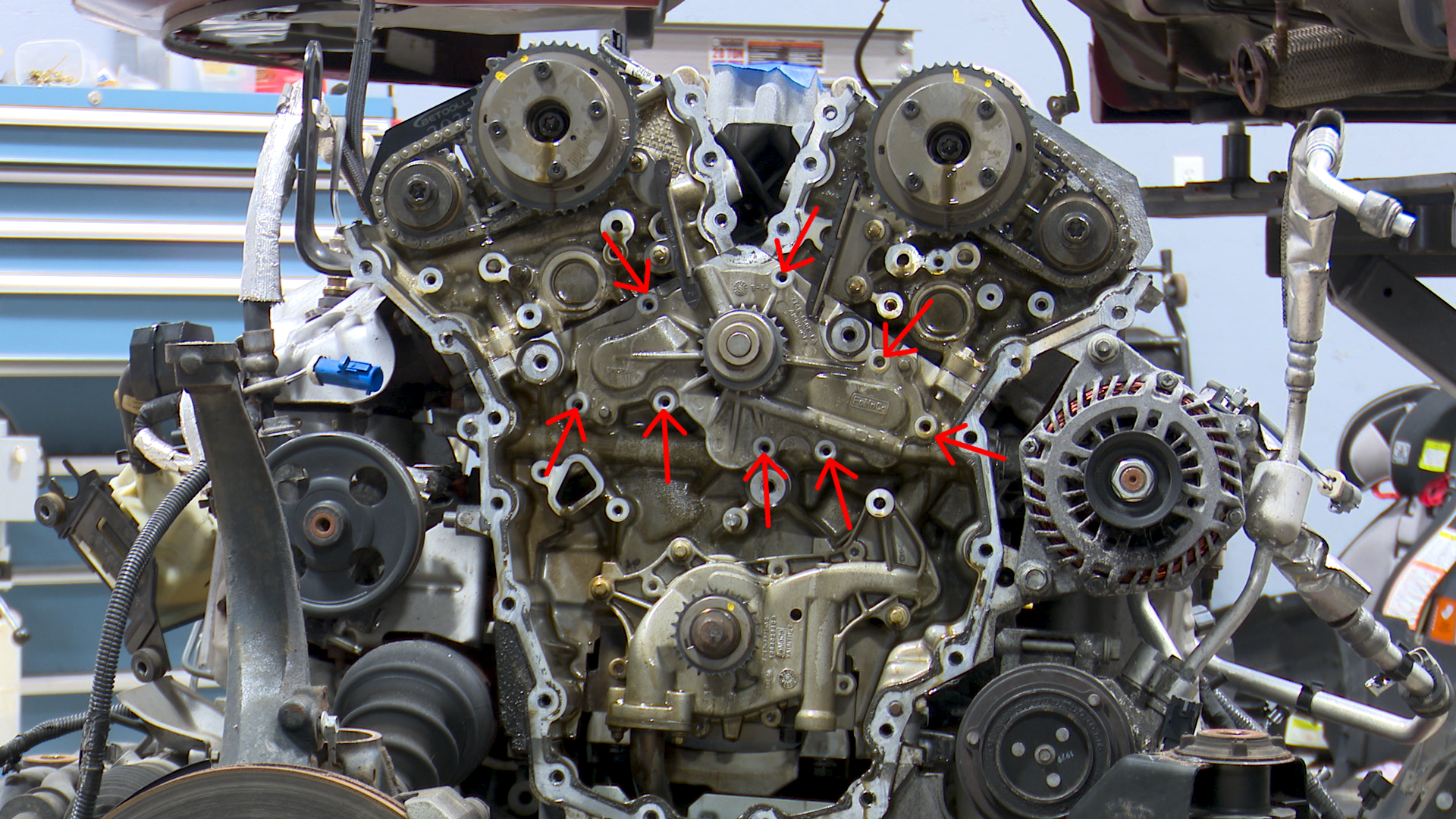 Enlarge the pump-location image
The cover and primary chain are already off in this view. The pump’s sprocket is in the center; the red arrows identify its mounting bolts.
Coolant loss started this repair
The complaint was coolant loss. Mike explains that the pump was leaking internally into the crankcase, contaminating the oil. With the chain removed, he also finds the old pump hard to turn.
Coolant loss or contaminated oil on another vehicle still needs diagnosis. This case alone doesn’t establish that its pump has failed—or that replacing a pump will resolve any engine damage.
The complaint and repair decision · 0:24 · Inspecting the old pump · 7:57
Why replace the timing chain with the pump?
In this job, the primary chain has to come off to reach the pump. Mike says they are not replacing it for a timing or stretch complaint; the customer chose a new primary chain, guides and tensioner while it was apart.
He leaves both secondary chains installed. That’s the scope of this repair, not a rule that every water-pump job needs the same parts.
Shown here
- Primary-chain removal and installation
- Water-pump removal and installation
- Primary guides and tensioner
- Final mechanical timing check
Still to plan for your vehicle
- Access and engine support
- Exact pump, sprocket and chain configuration
- Contamination assessment and cleanup
- Reassembly, fluids and running checks
Does the engine have to come out?
Mike works with the engine and powertrain assembly out of the Fusion. He calls that probably the easiest way for this job. The video does not compare in-car access or show a complete engine-removal procedure.
Don’t turn that into an engine-removal rule for every Ford 3.5L. Check the procedure and equipment for your exact vehicle before choosing how to tackle it.
See the starting setup · 1:13 · Preparation in the repair guide
Which Ford 3.5L water-pump setup do you have?
Start with the engine and the installed parts, not just “3.5L” on the vehicle description.
2010 Fusion · internal pump
The primary timing chain drives the pump. Mike replaces that chain and the pump, leaving the two secondary chains installed. The demonstrated pump has a single-row sprocket.
Open the sourced parts/application check →Check the exact configuration
Cloyes documents internal and external pumps, different primary-chain types and different VVT layouts across the Ford 3.5L/3.7L family. Displacement alone doesn’t identify the parts or access procedure.
Cloyes configuration notes →A model match is a starting point. Use the VIN/build and the installed pump-sprocket setup to confirm parts. Use that vehicle’s service information to confirm access and installation. The Fusion demonstration doesn’t settle an Explorer, Taurus, Edge or EcoBoost procedure by itself.
Before you order parts or start the job
Does this cover an Explorer, Edge or Taurus?
Use the repair guide’s application and configuration notes as a starting point. A parts listing does not establish identical access, pump drive or repair steps for another model. This page does not extend the Fusion procedure to every Ford 3.5L or EcoBoost engine.
Compare the documented timing setups · Vehicle and parts checks
What should a water-pump repair quote include?
You want to know what the shop is fixing, what it found and how it will check the result. Use these questions to compare the actual work, rather than just the bottom-line price.
What established that the pump is the leak source?
Ask for the inspection or test finding, and whether coolant reached the oil. Mike’s video shows the failed pump; it does not supply the original leak-diagnosis results for another vehicle.
What timing parts are included, and why?
Separate parts removed for access from parts chosen for replacement. In this case the primary chain comes off for pump access, while replacing it was part of the customer’s chosen repair.
Does the quote cover access, cleanup and reassembly?
Ask how the engine will be accessed and supported, what contamination work is included, and what seals, fluids and vehicle-specific reassembly work are needed. That makes omissions easier to spot without inventing a universal labor time.
What findings will show the job is ready to return?
Ask which mechanical timing, cooling-system and running checks are included, and how any contamination or engine-condition concerns will be resolved. Keep those findings separate from “the new pump is installed.”
Take these questions to the shop
Keep the findings, work and final checks in the same conversation.
Read the checklist
GOTECH · SHOP CHECKLIST
Ford internal water-pump repair: shop checklist
From Mike’s 2010 Fusion 3.5L example. Confirm your vehicle’s setup and procedure; this is a planning checklist, not repair instructions.
- What established the leak source?
Ask for the inspection or test finding. Was coolant found in the oil, and what does that mean for the engine’s condition?
- Which parts are included, and why?
Separate parts removed for access from parts chosen for replacement. Confirm the installed pump-sprocket and timing setup.
- Does the quote cover the whole job?
Agree on access and engine support, contamination assessment/cleanup, seals, fluids and reassembly.
- What checks will verify the result?
Ask how mechanical timing, the original coolant-loss complaint and the running result will be checked. An installed pump is not the finished result.
Use this to agree on the next check. It does not replace your vehicle’s service information or a written estimate.
Guide: https://gotech.com/articles/ford-3-5l/internal-water-pump
The pump is in. What still needs finishing?
- Mechanical timing — shown. The repair guide finishes its timing work with the holding-tool recheck.
- Cleanup and reassembly — planned off camera. Mike describes cleanup, reassembly and fresh oil as work still to do. Use the vehicle’s procedure for seals, fasteners and fluids, and address the contamination found.
- Cooling-system and running result — still to verify. Agree on the checks for the original coolant-loss complaint and engine condition. The source does not show a completed running result for this Fusion.
Coolant during pump removal · 9:30 · What Mike plans to do next · 22:49
Follow the repair without losing the checks
- Before removal
Position the engine and establish the holding-tool setup.
See the setup checkpoint → - At the new pump
Check the mounting area and locating pins; follow the specified tightening sequence.
See the installation checkpoint → - After chain installation
Rotate and recheck the mechanical timing, then finish the rest of the job.
See the final timing check →
Ready for the illustrated repair?
The full guide keeps the sequence, diagrams and source video together. Choose the stage you need, then follow its preparation and checks.
Watch Mike’s original repair
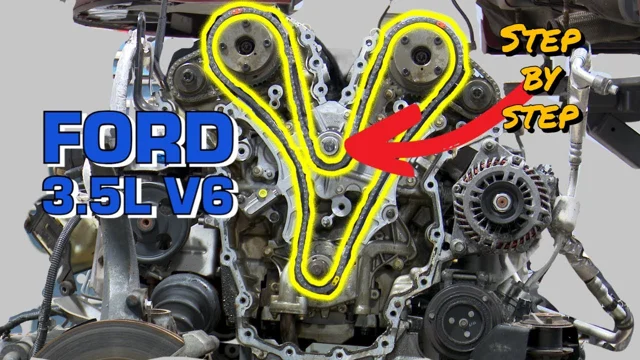
Video loads only when you choose to play.
Where this guide comes from
Written from GoTech’s original 2010 Fusion demonstration and its repair illustrations. The source moments above play here on the page. This is repair planning for that documented case, not a complete diagnostic procedure for every Ford 3.5L.
Original video by Mike. Companion by GoTech · October 21, 2026.