P0420 identifies catalyst efficiency below threshold on Bank 1; P0430 refers to Bank 2. The code alone does not identify which part to replace. GoTech's filmed four-cylinder Camry has one bank.
The label tells you which monitored bank is involved. It does not, by itself, choose a replacement part. GoTech's filmed four-cylinder Camry has one bank, so its case is not a Bank 2 demonstration.
Read what P0420 meansGoTech guide · Inspected local P0420 guide, section#code-meaning
The video follows a 2002 Toyota Camry 2.4L with California emissions. Compare that with your year, model and engine before borrowing its layout or conclusions. Unknown details can stay unknown while you read the general explanation.
The example is not an automatic vehicle match.
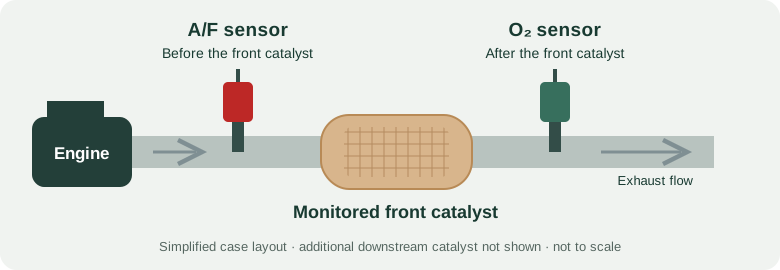
GoTech’s filmed 2002 Camry 2.4L. A/F sensor → monitored front catalyst → rear O₂ sensor. Original explanatory drawing; the second downstream catalyst is omitted. Toyota source and scope. Open full-size diagram ↗
The case identifies a 2002 Toyota Camry 2.4L with California emissions. A similar year or model name does not establish the same sensors, converter layout or applicable service guidance. Start with the year, model and engine already shown in your vehicle documents; leave uncertain details unknown.
P0420 alone does not select a converter or sensor. Walker highlights other codes and leaks; GoTech's technician explains several observations before replacing anything. A blog's cheaper-sensor suggestion is not evidence that your sensor failed.
Walker starts with other engine codes and leaks. GoTech's presenter explains several observations before his decision. A retailer blog's suggestion to try a cheaper sensor is a different kind of claim: a purchase suggestion does not establish that sensor's failure. None of these links selects a part or cleaner for your car.
What this establishes: Explains the demonstration, does not prescribe its tests
The retailer blog presents downstream-sensor replacement as a cheaper diagnostic step; that is an editorial suggestion, not evidence that a viewer's sensor has failed.
Other codes change the context. Walker specifically highlights P0300-series misfires before catalyst evaluation. Keep the full code list and the order in which symptoms appeared together when comparing a source with your car.
Walker specifically highlights P0300-series misfires in its starting checks. A lone-code Camry story cannot settle a car with additional faults. The useful next information is the complete code list and what was happening when it appeared, rather than a guess at the next part.
The presenter found the leak after the rear sensor and did not attribute this Camry's P0420 to it. He continued checking the catalyst and sensor evidence. Watch the segment to see why location mattered in this case.
2002 Camry case; not a rule to ignore other leaks.
He located it after the rear sensor and continued his investigation. That is his case interpretation, not a general rule to ignore downstream leaks. Watch the original segment for the location and reasoning; the resource does not turn the demonstration into a new test procedure.
On the documented 2002 Camry 2AZ-FE, the front sensor is A/F and the rear is conventional heated O₂. Their signals differ. Identify the sensor type before applying a rule that expects two conventional oxygen-sensor traces.
Toyota's application diagram and DENSO's type explanation.
GoTech’s filmed 2002 Camry 2.4L. A/F sensor → monitored front catalyst → rear O₂ sensor. Original explanatory drawing; the second downstream catalyst is omitted. Toyota source and scope. Open full-size diagram ↗
Toyota's 2002 Camry 2AZ-FE diagram labels Bank 1 Sensor 1 as A/F and Sensor 2 as heated O₂. DENSO explains why their signals differ. That establishes a sensor-type distinction, not whether a particular graph or sensor is good.
What this establishes: Sensor-type distinction; no diagnosis from a screenshot
The presenter describes the filmed Camry's exhaust order as an upstream A/F sensor, the monitored front/manifold catalyst, then a conventional rear oxygen sensor. A second catalyst is farther downstream, with no third monitoring sensor described.
A two-conventional-sensor shortcut does not carry over to this Camry's A/F front sensor. The older GoTech text includes an A/F exception. Sensor identity and source scope come before interpreting a graph as a pass or fail.
The collection supplies no universal waveform threshold.
◉
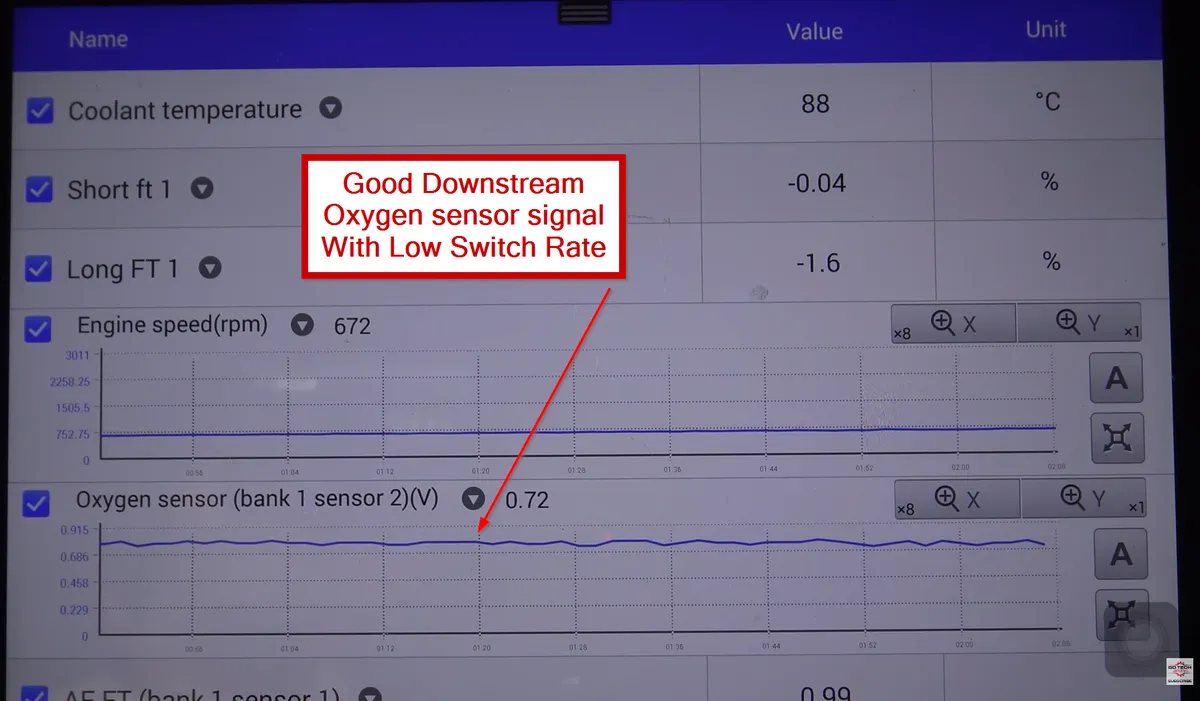
Keep the conditions with the picture. The original steady-trace still shows 672 rpm. It is not a matched-condition before/after comparison. Compare the original illustrations →
The legacy diagnosis article uses broad front-versus-rear wording, but also includes an A/F exception. The legacy code page explicitly excludes A/F systems from its switch-ratio test. Use the identified sensor types and source scope; this resource supplies no universal graph threshold or diagnosis from an image.
Read the application contextGoTech guide · Inspected local current-guide copy, section#application-checks; legacy A/F exclusion remains separately pinned
The legacy GoTech diagnosis guide's two-trace shorthand needs its A/F exception; the code overview explicitly excludes A/F systems from its generic switch-ratio test.
The older GoTech article expressly excludes wideband and A/F sensors from its four-wire heated-O₂ testing. DENSO explains the signal distinction. The current GoTech URL opens a newer rear-sensor guide.
An older article's scope, not an A/F test procedure.
Its old title was broader than its stated scope. The current URL opens a newer rear-sensor guide, so the legacy limit is recorded here rather than promised at that link. DENSO explains the type distinction. No test instruction or numerical range is transferred to an A/F sensor here.
Start at the rear-sensor graph, then compare the separate response check at 6:15 and the decision at 7:01. They are different observations in the presenter's reasoning, not one screenshot declaring a failed part.
Those are different observations in the presenter's reasoning. The links preserve the original demonstration; they do not make its conditions or decision a general instruction for another vehicle.
The presenter reports a steadier rear trace, completed monitors and a Wisconsin emissions pass. Watch his post-repair account. The legacy still shows 672 rpm, so it is not a matched comparison with the earlier 2,000-rpm observation.
Reported video outcome; certificate not independently checked.
◉
Keep the conditions with the picture. The original steady-trace still shows 672 rpm. It is not a matched-condition before/after comparison. Compare the original illustrations →
That is the filmed car's reported outcome; the inspection certificate was not independently checked. The legacy still displays 672 rpm, so it is not a matched comparison with the earlier 2,000-rpm observation. Return to the original post-repair segment for the presenter's account.
A returning P0420 does not tell you which part to replace next. Keep the changed part, the original evidence and the latest code or reported result together. GoTech's repair-return section helps compare what changed; the forum is one unverified experience.
GoTech's repair-return section distinguishes new codes or symptoms, work performed and the same returning P0420. Keep the changed part, the evidence behind that choice and the latest report together. A returning code does not choose the next part. The linked forum is one unresolved owner's account, retained as secondary experience.
GoTech's repair-return section compares the new code list and result with the original fault and work performed. It states that a returning code alone does not identify the next replacement part.
Confidence: Owned editorial explanation, inspected in the local guide copy
What this establishes: Compare the record and source context; no part selected and no physical diagnostic procedure added
An October 2021 forum post reports P0420 returning on a 2005 Camry after converter and upstream-sensor replacement; the reviewed thread has no confirmed resolution.
That reply describes a different layout from the two-sensor GoTech case. Its car's actual layout is unverified here. Toyota's 2002 Camry 2AZ-FE diagram identifies the front A/F and rear heated-O₂ sensors for that application.
A shared model name does not settle the mismatch.
GoTech’s filmed 2002 Camry 2.4L. A/F sensor → monitored front catalyst → rear O₂ sensor. Original explanatory drawing; the second downstream catalyst is omitted. Toyota source and scope. Open full-size diagram ↗
The reply describes three sensors; the 2002 case describes two around the monitored front converter. Toyota's application diagram supports the A/F-front and heated-O₂-rear identities for that 2002 engine. The forum car's actual layout is not verified here; the disagreement stays visible.
A reply's three-sensor description conflicts with the two-sensor description of the filmed 2002 Camry; a shared model name does not resolve that application difference.
GM PI1505 is a specific example: a July 2015 bulletin for the 2013 Cruze 1.4L turbo LUV discusses ECM campaign status. It is not a Camry or all-Cruze instruction; a 1.8L is outside its listed application.
Historical bulletin; current applicability and revision unknown.
GM PI1505 covers a 2013 Cruze 1.4L turbo LUV and discusses ECM campaign status before further P0420 work. It does not cover every Cruze, a 1.8L by this listing, or the Toyota case. Current applicability and revisions still need confirmation; no update or repair is directed here.
This collection covers P0420 and a few related distinctions. It has no sourced answer for an unrelated code. Use the code exactly as reported when looking for another resource.
No match is better than borrowing an unrelated diagnosis.
Why this answer? Sources & details +
It has no answer for an unrelated code or an undocumented vehicle-specific procedure. A keyword match is not evidence that a source applies. Return to GoTech's broader content or use the code exactly as reported when looking for the next source.
In GoTech's case, intact honeycomb and no rattle did not change the technician's conclusion. He had already based it on the earlier findings. The appearance comment comes after the decision and removal segment begins.
The presenter reports intact honeycomb, no obvious broken pieces and no rattle after his decision to replace it. His reasoning came from the earlier leak and sensor findings. Appearance was one observation, not an efficiency result.
After deciding to replace the converter, the GoTech presenter describes its honeycomb as intact, with no obvious broken pieces or rattle. That appearance did not change his case diagnosis.
GoTech: P0420 diagnosis on a 2002 CamryOwner-supplied untimed transcript line 15; original guide chapter 7:01 starts the decision/removal segment, not the exact instant of the appearance comment
Confidence: Attributed observation in the original demonstration; not an independent inspection
What this establishes: Explains this case; appearance alone does not supply an efficiency measurement or a test procedure
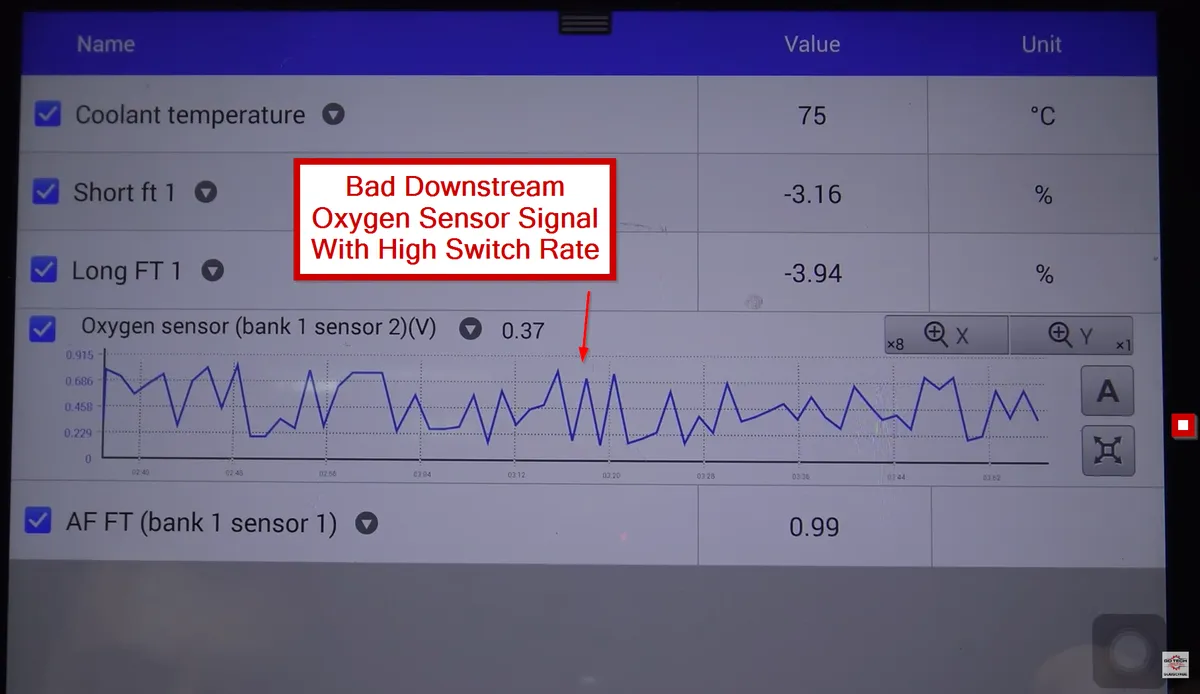
The case separates the moving rear-sensor trace, its response check, and the presenter's replacement decision.
The old image labels two downstream sensors close together. Its vehicle is unidentified, and it does not show the filmed Camry's front-and-rear pair. For that Camry, start with the video's layout.
Image application unknown; use the labeled vehicle example.
GoTech’s filmed 2002 Camry 2.4L. A/F sensor → monitored front catalyst → rear O₂ sensor. Original explanatory drawing; the second downstream catalyst is omitted. Toyota source and scope. Open full-size diagram ↗
Its vehicle is not identified in the guide, and the broad alt text does not match the image's own annotation. For the filmed 2002 Camry, start with the video's layout and Toyota's application diagram instead.
The old location illustration labels two downstream sensors, while its article alt text describes upstream versus downstream. The pictured vehicle is unidentified; this image does not establish the filmed Camry's sensor positions.
Confidence: Primary manufacturer document on official archive
What this establishes: Exact documented application; sensor identity only
The presenter describes the filmed Camry's exhaust order as an upstream A/F sensor, the monitored front/manifold catalyst, then a conventional rear oxygen sensor. A second catalyst is farther downstream, with no third monitoring sensor described.
Read the graph in context. GoTech low-switching rear-O2 illustration; display shows 672 rpm. A dated illustration, not a matched-condition 2,000-rpm before/after comparison. View the GoTech caseA trace is not a parts verdict. GoTech rear-O2 trace with substantial switching. The original bad-signal annotation does not prove the sensor itself failed; the case separately checks response. View the GoTech case
CHECK THE SOURCE
Different sources. Different kinds of evidence.
Manufacturer documents have specific applications. GoTech shows an original case. Forum posts describe experiences. Each answer keeps those differences visible.
GoTech demonstrationGoTech: P0420 diagnosis on a 2002 Camry+
Applies to: Filmed 2002 Toyota Camry, 2.4L four-cylinder, California emissions, about 338,000 miles; presenter's description.
Limits: Case observations and claimed outcome, not an independently verified inspection or a procedure for another vehicle. Owner-supplied transcript is untimed; chapter offsets come from the legacy guide. Video was not freshly watched in this review.
2020-07-09
GoTech-attributed material already in the owner-authorized repository. This source projection uses original explanations and links; repository possession is not proof of rights to every embedded third-party asset.
Applies to: Legacy guide mixes general P0420/P0430 wording with the filmed Camry example.
Limits: The current public page differs from this pinned legacy version. Legacy two-trace wording must be read with its A/F-sensor exception; this projection does not adopt a universal graph threshold.
2023-02-22 (legacy repository snapshot)
GoTech-attributed material already in the owner-authorized repository. This source projection uses original explanations and links; repository possession is not proof of rights to every embedded third-party asset.
Applies to: General code explainer; individual vehicle diagnosis is not established by a code label.
Limits: Use the pinned code definitions and explicit A/F exclusion. The current public page is newer and does not reproduce this snapshot. Broad cause rankings, numerical ratios and driving assurances are not adopted.
2023-02-22 (legacy repository snapshot)
GoTech-attributed material already in the owner-authorized repository. This source projection uses original explanations and links; repository possession is not proof of rights to every embedded third-party asset.
Applies to: The legacy article expressly limits its testing to four-wire heated oxygen sensors, excluding wideband/A/F sensors.
Limits: The current public page is a newer rear-sensor guide, not the legacy four-wire article. Its URL is current navigation, not a promise to display the pinned legacy paragraph. No test steps or ranges transferred here.
2023-02-22 (legacy repository snapshot)
GoTech-attributed material already in the owner-authorized repository. This source projection uses original explanations and links; repository possession is not proof of rights to every embedded third-party asset.
Applies to: 2002 Camry, 2AZ-FE engine; printed EG-62, PDF page 32.
Limits: Sensor identity and layout context only. This is not a P0420 diagnostic specification, a parts catalog or proof that another year/engine/emissions configuration matches.
Public read-only access verified; concise attributed paraphrase and link only. No full text, diagrams or restricted service content copied. Public access is not a commercial reuse license.
Applies to: General exhaust-supplier guidance; no particular vehicle application specified.
Limits: Used for the importance of other engine codes and leaks. Its generic graph values are not adopted as vehicle-specific pass/fail limits.
Public read-only access verified; concise attributed paraphrase and link only. No full text, diagrams or restricted service content copied. Public access is not a commercial reuse license.
Manufacturer technical explanationDENSO: Air/fuel ratio sensors and oxygen sensors — what’s the difference?+
Applies to: General sensor-type explanation, not a particular vehicle's scan-PID specification.
Limits: Explains differing signals and non-interchangeability. Does not diagnose a sensor or converter from a viewer's graph.
2022-03-01
Public read-only access verified; concise attributed paraphrase and link only. No full text, diagrams or restricted service content copied. Public access is not a commercial reuse license.
Manufacturer bulletinGM PI1505: Diagnostic Tips for DTC P0420+
Applies to: 2013 Chevrolet Cruze with 1.4L turbo gasoline engine, RPO LUV.
Limits: Historical bulletin for professional technicians. Current revision, campaign eligibility and an individual VIN's applicability are unverified. No software operation or physical procedure reproduced.
2015-07
Public read-only access verified; concise attributed paraphrase and link only. No full text, diagrams or restricted service content copied. Public access is not a commercial reuse license.
Reported owner experienceCamry Forums: P0420 returned after converter and sensor replacement+
Applies to: Post #1 reports a 2005 Camry LE 2.4L; that identity and work are self-reported.
Limits: Unverified account and speculative reply. No confirmed final fix appears in the two-post thread reviewed. Reply #2's three-sensor layout must not be imported into the 2002 filmed case. No usernames or contact information retained.
2021-10-18
Public read-only access verified; concise attributed paraphrase and link only. No full text, diagrams or restricted service content copied. Public access is not a commercial reuse license.
Retailer editorial claimGo-Parts: P0420 on 2007–2011 Toyota Camry 2.4L+
Applies to: Article's stated range is 2007–2011 Camry 2.4L; actual model/engine coverage is not independently established here.
Limits: Commercial parts-retailer article, not an OEM procedure or a verified repair case. Cause rankings, sensor-replacement suggestions, prices and driving assurances are not adopted.
Public read-only access verified; concise attributed paraphrase and link only. No full text, diagrams or restricted service content copied. Public access is not a commercial reuse license.
Original case illustrationGoTech legacy steady-signal illustration+
Applies to: Illustration associated with the filmed Camry; visible engine-speed row is 672 rpm.
Limits: Illustration of one displayed condition. It is not a matched 2,000-rpm comparison or a universal good-signal specification.
2023-02-22 (containing legacy article)
GoTech-attributed material already in the owner-authorized repository. This source projection uses original explanations and links; repository possession is not proof of rights to every embedded third-party asset.
Original editorial illustrationGoTech legacy illustration: two downstream sensors close together+
Applies to: Vehicle and engine not identified in the legacy article. Image annotation describes two downstream sensors; it is not a labeled layout of the filmed Camry.
Limits: The legacy alt text describes upstream versus downstream locations, but the actual annotation identifies two downstream sensors. Use as a source-scope comparison, not as Camry sensor placement or fitment authority.
2023-02-22 (containing legacy article)
GoTech-attributed image already in the owner-authorized repository. Original creator and any third-party component rights are not independently documented here; product asset review remains separate.
Applies to: General code explanation in the existing local P0420 guide; one-bank filmed example remains separate.
Limits: Exact section verified in the sealed local guide copy. The public URL's current fragment/content was not separately reverified for this candidate; local product routing uses the inspected copy.
Existing GoTech guide reused under the owner's local-content instruction; a short source pointer, not a new third-party content acquisition.
GoTech guideGoTech: Code returned after the repair?+
Applies to: Existing GoTech reading that distinguishes changed symptoms, work performed and a returning P0420; a particular failed part is not established.
Limits: Section verified in the sealed local guide copy. The public fragment was not freshly verified for this candidate. Its physical checks and procedures are not reproduced in this answer.
Existing GoTech guide reused under the owner's local-content instruction; concise explanation and a pointer to the inspected section.